
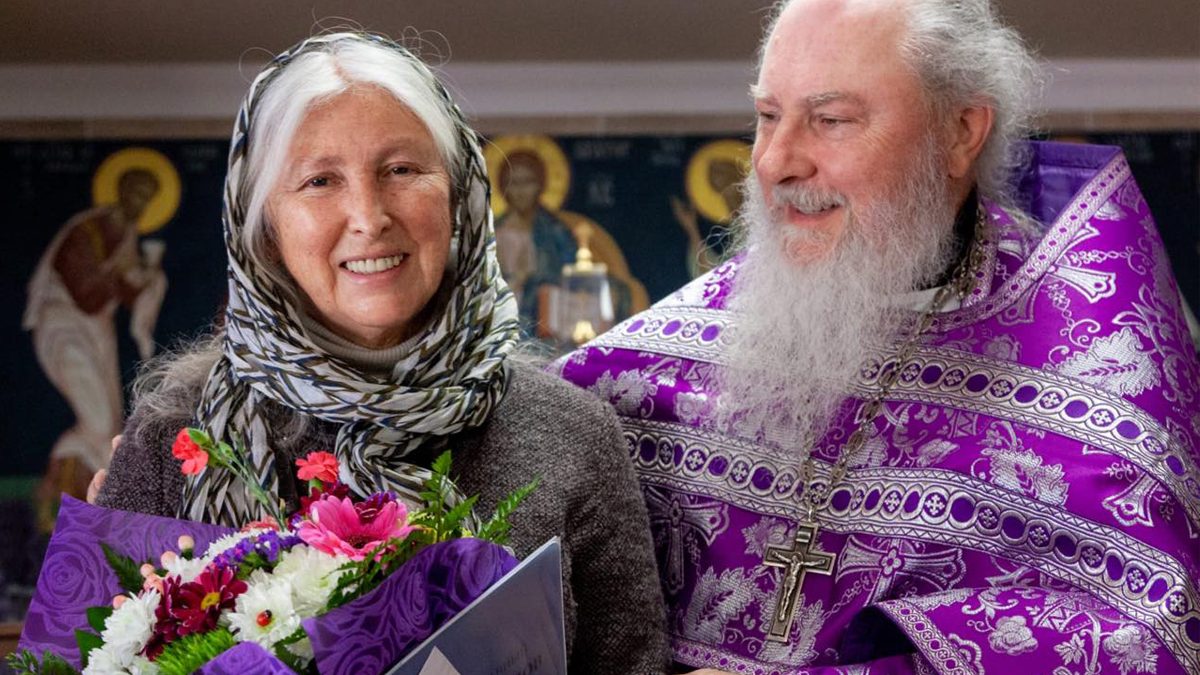
An Unexpected Path to Priesthood
OR: Father Alexander, you once wrote: “In 1984, I was still an artist, but by God’s mercy, I was led to the village of Alekshino in the Ruza District of the Moscow Region, to the Church of the Protection of the Most Holy Theotokos, to serve as an altar server.” Could you recall how the Lord led you to the priesthood? What spiritual struggles or temptations did you experience on that path?
AT: I came to the priesthood through a series of circumstances—through my own foolish self-confidence and, of course, through Divine Providence.
I first served as an altar server, then a reader, then a singer and choir director. I dreamed of becoming a deacon. I collected recordings of famous deacons, studied the pre-revolutionary and Old Believer styles of diaconal service, and imagined myself (I had a decent voice) bellowing the great liturgical petitions from the bottom of the church to the top at a hierarchal service: “For a prosperous and peaceful life…”
The Lord heard my dreams, as He often has, and fulfilled them—in 1989, I became a deacon. For two years, I enjoyed this wondrous, angelic ministry: the first year at the Novo-Golutvin Convent, and the second at a cathedral where the rector later broke away into schism and was defrocked.
After a year under his leadership, witnessing all the spiritual temptations surrounding the cathedral, I was so overwhelmed by what I saw that I was ready to flee anywhere. But the rector loved grandeur in the services, and he wasn’t about to let a booming-voiced deacon go. As the dean of the entire district, he could only “release” me if I agreed to become a priest, because at that time, many ruined churches were being returned to the Church and needed priests to serve in them.
It was the only way out. And I thought, “Well, others with far less experience in church life have been ordained, and they seem to manage. Why shouldn’t I?” (Oh, the foolishness and self-confidence!!!)
So I went to my spiritual father, described the situation, and laid out three possible paths:
1. Stay, endure, and don’t make a fuss.
2. Ask to be transferred as a deacon to another church (100% unrealistic).
3. Petition for ordination as a priest.
My spiritual father listened, sighed, and said, “Go become a priest…”
And so I did. But that is another story.
OR: Could you share some of the spiritual experiences you had during your pilgrimage to Mount Athos?
AT: I’ve already written about this in several of my books, and I doubt I could add anything substantial here. I’ll just say this: As long as Athos prays, the world stands.
The Challenge of Pastoral Burnout
OR: From time to time, Orthodox websites discuss the topic of pastoral burnout. What do you think about this?
AT: It’s a sad topic. I understand those who “burn out”—especially those who plunged into priestly service with full commitment, only to be hit by all the problems and challenges of Church life.
But… without judging or blaming anyone (God forbid!!!), I have to ask: could Christ have “burned out” during His three years of public ministry, when He faced far greater spiritual opposition than any of us ever will?
So, you give yourself a little kick, “blow on the embers and throw on some kindling” so you don’t burn out.
After all, the time of our death is near, no matter how many years God gives us. It’s still a fleeting moment. Soon! Maybe today I’ll be pulled, piece by piece, from a mangled car after an accident, or perhaps I’ll lie down for a nap and a vessel will burst in my brain (like my father), or something else will happen. And then I’ll find myself standing before the crucified Christ—the One who died for me (for me!!!)—and I’ll look into His eyes.
What will I say then? “Sorry, Lord, I burned out”?
When I first received a blessing to serve as an altar server in 1984, my spiritual father pointed to the small analogion (lectern) with the Cross and Gospel on it and said, “Right now, you see church life like this.” Then he took the edge of the analogion cover and flipped it inside out, revealing the underside, “But now you’ll see it like this. Be careful not to lose your faith.”
By God’s mercy, I haven’t lost my faith yet, and I haven’t burned out, though I’ve seen plenty along the way…
What Makes a True Spiritual Father?
OR: What do you think about spiritual mentorship? Who can truly be called a spiritual father? What qualities should he possess? What temptations should be avoided? Could you share some examples from your own experience?
AT: Blessed is the one who has received the great gift of a good spiritual father from God! I have had this gift and still have it, thank God!
A true spiritual father is someone who treats you as a beloved son or daughter, who cares for your salvation as if you were his own child. The rest are just spiritual guides, mentors, advisors, and so on.
The most important quality of a spiritual father is Love, followed closely by sound judgment. Everything else will follow if both the spiritual father and his spiritual children strive to live according to the Gospel and pray for each other.
There are countless temptations in the relationship between a spiritual father and his spiritual children, but the main one is insincerity.
From personal experience: “How should I bless you: the way I think is right, or the way you want?”
Reflections on Life in Portugal
OR: You wrote that you now live in Albufeira. Why did you choose Portugal? What do you find interesting in this country? Can you share some impressions, connections, or travel experiences?
AT: The ways of Divine Providence are unfathomable. If someone had told me ten years ago that I would be living in Portugal and running a spiritual-cultural center, I would have fainted…
And yet, here I am—living in Portugal and leading a spiritual-cultural center, as much as my strength allows.
The first thing I heard about Portugal, about 15 years ago, was in a guesthouse on Mount Athos. I asked a Russian pilgrim who had become a Portuguese citizen, “What kind of country is Portugal, anyway?” His answer was: “It’s a poor country, but the people are kind.”
And then, suddenly—just like that—I found myself living here! It all came together naturally. I was looking for a place to spend my winters (on my doctors’ advice), considering Greece, Italy, even Sicily (it’s warmer there), and then—bang!—Portugal!

Once I arrived and saw the shortage of priests here and the great spiritual needs of the Russian-speaking community, I realized that the Lord had brought me here for a reason. In a place where “fish are scarce,” even a disabled priest has a place. The Dean of the Portuguese churches, Father Ioann, asked for my help, the bishop gave his blessing, and as long as I am able, I will help. Tomorrow? Whatever the Lord wills! We’ll live, we’ll see!
The country really is not wealthy, and the people are generally good-natured.

Portugal is beautiful, but not with the dramatic, striking beauty of Greece or Italy. It has a quiet, humble, inward beauty. The spirit of the country and its people is peaceful, which is unfamiliar to us Russians (especially Muscovites). There’s no road rage, no need to look cool or rich, no constant competition to “stand out” or “seem rather than be.” There are many foreigners here, people of all skin colors and eye shapes, and they generally treat each other with respect and calmness. And problems? Where aren’t there problems?
And there are so many retirees from various northern European countries—especially in the winter, when the tourist season ends. You see old couples walking hand-in-hand along the ocean… Sometimes my wife and I do the same.
Glory to God for all things!

Interview conducted by Olga Rozhnova, October 9, 2019. Translated from the original Russian by Alpha Omega Press.